TGEU publishes Trans human rights, realities, and resilience in Europe: An analysis of the EU LGBTIQ Survey III 2023
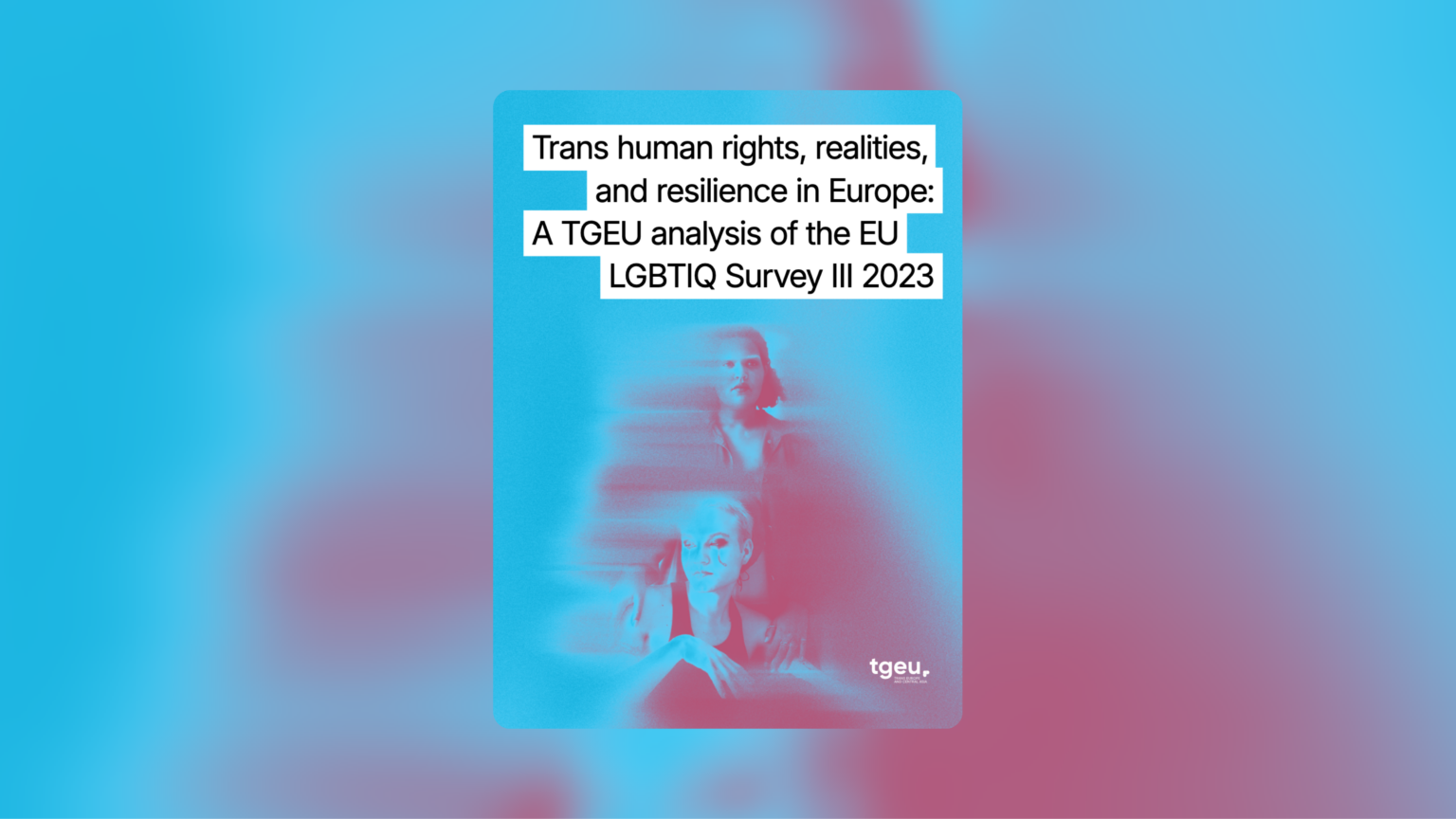
TGEU publishes a new report presenting data and findings from trans respondents to the EU LGBTIQ Survey III, conducted in 2023 by the European Union Agency for Fundamental Rights (FRA).
Why this report
With 30,627 trans participants from the EU27 (plus Albania, North Macedonia and Serbia), it is the largest survey of trans people in the EU to date. The survey results provide a crucial socio-demographic resource on the EU trans population, detailing their experiences in areas such as openness, healthcare, legal issues, discrimination, violence, and wellbeing.
By bringing trans issues to the forefront, the report offers a more nuanced and intersectional analysis of trans respondents than the original report.
Intersectional analysis
The report uses an intersectional, disaggregated quantitative approach. This allows for the various interconnected social and political identities of trans respondents to be recognised and uncovers how their lives are shaped by broader social structures and power dynamics. Such an approach is essential when researching the multilayered and intertwined societal norms and forces that result in a variety of injustices and inequalities.
Report Sample
The EU LGBTIQ Survey III report presents data from 30,627 trans people (trans women, trans men and non-binary and gender diverse people), which represent 30.6% of the total sample (99,972). This is a significant rise from 20,933 trans respondents in the previous LGBTI II Survey in 2019. The increase in trans respondents is especially notable considering that overall, there were almost 40,000 fewer respondents compared to the previous survey.
The present survey was the first time the EU FRA included Q (queer) in the survey title, which may have recruited some additional respondents who identify as queer, but not LGBTI. 81.1% of trans respondents considered themselves queer, vs just 58.1% of cis LGBTI respondents.
Key findings of the report
Trans socio-demographics
- 65.5% of trans respondents identify as non-binary or gender diverse, marking this as the fastest-growing segment of the trans community (up from 51% in 2019).
- Life satisfaction increases with age: While older trans people report the highest satisfaction, the lowest scores are clustered among subgroups such as trans unemployed/unable to work people, disabled trans people, trans youth and trans people with low income.
- Asexuality is notably more common in trans communities, with 16.8% of trans respondents identifying as asexual, compared to 3.4% of cis LGBIQ respondents. This survey marked the first inclusion of asexuality.
Openness, life satisfaction and wellbeing
- Trans respondents report significantly worse mental health outcomes compared to cis LGBIQ individuals. 44.7% feel downhearted at least more than half of the time (vs. 29.5% of cis LGBIQ respondents), and one in ten trans people report feeling depressed all the time.
- Almost one in four trans respondents said they often or always contemplated suicide, a rate more than double that of cis LGBIQ respondents (one in ten).
- Trans people have significantly less employment stability than the cis LGBIQ population: The unemployment rate for trans people is double that of cis LGBIQ respondents (9% vs. 4.2%). Despite similar education levels, trans women are also more likely to be unemployed than trans men or non-binary people.
Discrimination, violence and harassment
- Trans people experience higher rates of social exclusion and discrimination than cis LGBIQ people in almost all aspects of life.
- The results show an alarmingly high exposure to online harassment for the majority of trans respondents. Four in five are often or always subjected to hostile narratives.
- Almost half of trans men/trans women and one-third of non-binary people have been exposed to conversion practices, compared to just one in four LGBTIQ respondents overall.
Trans-specific experiences
- Legal gender recognition (LGR) reduces stigma and discrimination: 47.6% of trans respondents with LGR reported zero discrimination.
- One in four trans respondents have made interventions to change their body to better match their gender identity. 87.9% of those have also changed their gender marker.
Why it matters now
With the largest sample of trans respondents ever collected in an EU survey, the report doesn’t just show inequality; it provides the detail needed to help the people most affected, including non-binary people, trans youth, and disabled trans people.
These findings arrive at a critical moment. Trans communities across the EU continue to face rising hostility, from online harassment to exposure to conversion practices, stark gaps in mental health, employment, and legal recognition.
As anti-trans rhetoric and policy setbacks are on the rise, this report gives trans community members, advocates, journalists and policymakers the evidence to drive meaningful change and protect trans rights.
Your support makes change possible
We work across Europe and Central Asia to advance trans rights, build strong communities, and drive change through research, advocacy, and community-building.
Your donation helps us continue this vital work — defending trans lives, amplifying trans voices, and advocating for justice every day.

Views and opinions expressed are however those of TGEU only and do not necessarily reflect those of the European Union or the European Education and Culture Executive Agency (EACEA). Neither the European Union nor the granting authority can be held responsible for them.